The Real Reason OFM Agencies Lose Leads on Telegram (It's Not the Traffic)
Published April 9, 2026
Your chatters spend 20 to 40 minutes on every inbound lead. Most won't buy. That's not a traffic problem. It's where your conversion rate breaks, and creative testing won't fix it.
A lead sees the reel, taps the link, opens Telegram. They send a message.
Your chatter knows nothing. No name, no location, no read on whether this person has ever paid for anything online. So they start from scratch. Warm up, ask questions, try to get a signal. Twenty minutes pass. Sometimes forty.
The traffic isn't the problem. Your pre-sale layer is. And until you fix what happens before a human chatter opens a conversation, no amount of creative testing will move your conversion rate.
Telegram has a 98% message open rate. That's the channel working. The problem is what happens after the message is opened.
When a Lead DMs Your Creator
The moment a new lead hits your Telegram inbox, a clock starts.
Saw a reel. Clicked through. Sent a message. You don't know their age, location, or how serious they are. Neither does your chatter.
So the chatter warms up. Builds rapport. Asks questions they've asked a hundred times this week. They invest. Because that's the job.
Twenty minutes in, maybe forty, a signal emerges: this lead is real, or they aren't.
If they aren't, the chatter moves to the next conversation and runs it again from zero.
That's where the revenue disappears. Not in the traffic source. Not in the creative. Not in the targeting.
It disappears in the warmup phase. There's no filter before a human chatter has already spent a meaningful chunk of their shift on someone who was never going to buy.
Speed matters. But only with leads worth responding to. A Harvard Business Review study tracked 2.24 million sales leads and found that firms contacting leads within an hour were nearly seven times more likely to qualify them. The corollary stings: spending that hour on a lead who was never going to buy is pure cost.
Run the Numbers
Eight-hour chatter shift. Three to five active conversations at a time. Twenty to forty minutes per warmup that goes nowhere.
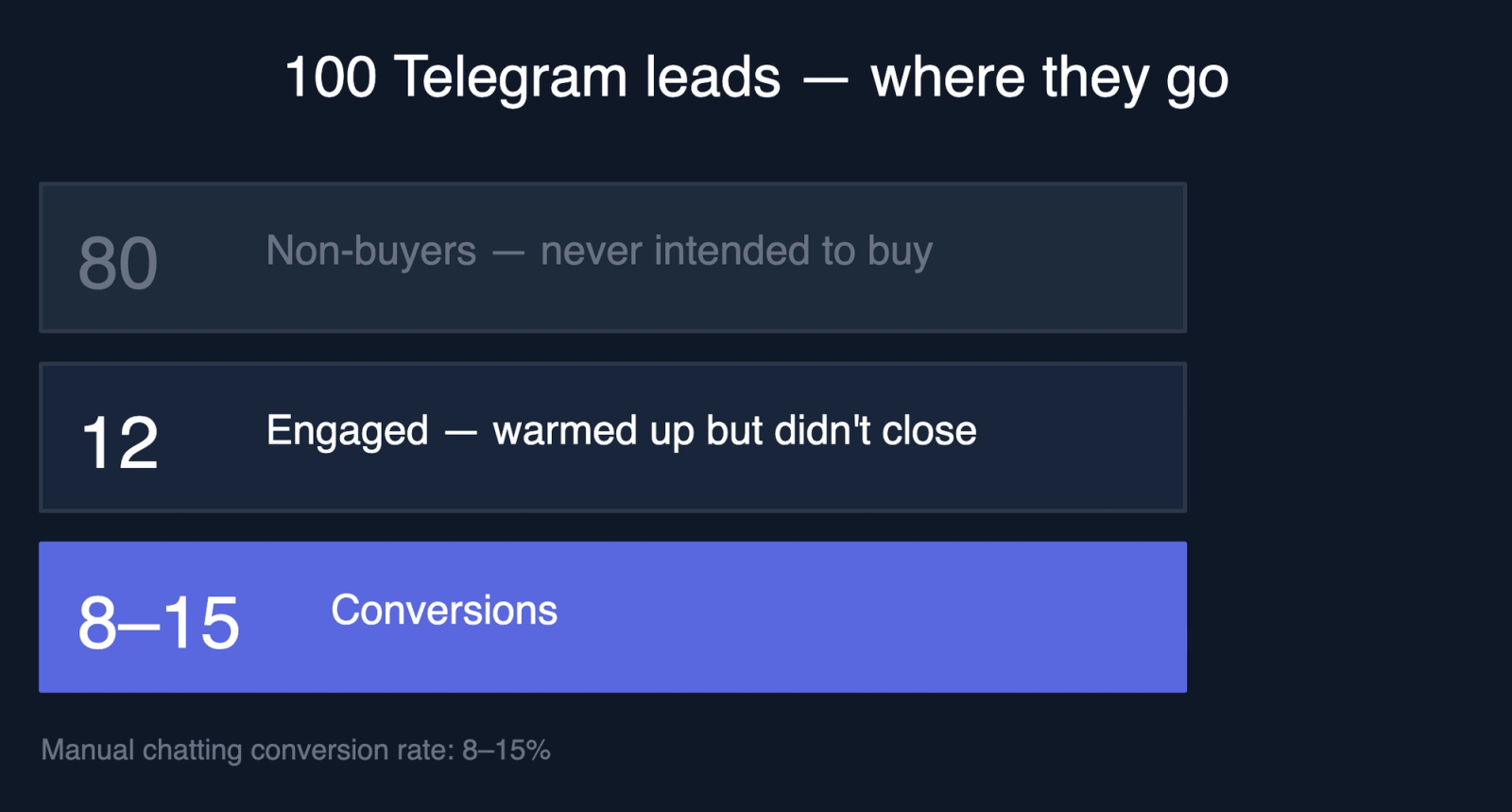
Most agency owners report that 70 to 80% of their inbound Telegram leads never buy. That tracks with what unfiltered social traffic produces. Which means the majority of every chatter shift runs on conversations that produce nothing.
That's not a traffic problem. Traffic does exactly what traffic does: it sends a mix of people, most of whom are browsing, some of whom will buy.
You can't separate the browsers from the buyers until a human chatter has already spent real time on both.
Agencies running manual chatting typically report conversion rates of 8 to 15%. For every 100 conversations your chatters open, 85 to 92 produce nothing. Each of those 85 conversations burned real time conversion rates of 8 to 15%. For every 100 conversations your chatters open, 85 to 92 produce nothing. Each of those 85 conversations burned real time.
Why Hiring More Chatters Won't Fix It
The instinct is to add capacity. More chatters, more conversations handled, more revenue.
True, to a point. Adding chatters doesn't change the ratio of buyers to non-buyers in your inbound.
Scale the team and you cover more ground. On the same broken mix. If 80% of your leads won't buy, a third chatter means three people running warmups that go nowhere instead of two.
The cost scales. The conversion rate doesn't.
That's not a growth play. It's running faster to stay in place.
The only way to change the outcome is to change what reaches the chatter's queue. Pre-qualification has to happen before a human opens the conversation: name, location, life situation, financial signals, real engagement across a warmup arc. If it does, the conversion rate on chatter time looks completely different.Pre-qualification has to happen before a human opens the conversation: name, location, life situation, financial signals, real engagement across a warmup arc. If it does, the conversion rate on chatter time looks completely different.
That's not a staffing problem. It's a pre-qualification problem.
What Makes a Lead Worth Closing
Qualification in OFM chatting isn't a checkbox. It's a picture built across a conversation.
A qualified lead has opened up: name, age, location, life situation. They've actually invested in the conversation: asked real questions, pushed back a little, reacted to the creator's world. That picture can't be drawn in a single message.
It takes a conversation that moves through rapport into real qualification. Done manually, that runs 20 to 40 minutes per lead minimum.
Most agencies treat qualification as something that happens during the sale. It doesn't. Or it shouldn't. They hand warm-but-unqualified leads to their best chatters and wonder why close rates stay flat.
The qualified-lead problem isn't a chatter skill problem. It's a process problem.
The issue isn't that qualification can't be done. It's that you can't do it at scale without the warmup cost eating the margin on every sale it produces.
How to Tell Which Problem You Have
They look identical from the outside. Same symptom: low conversion. Different causes, different fixes.
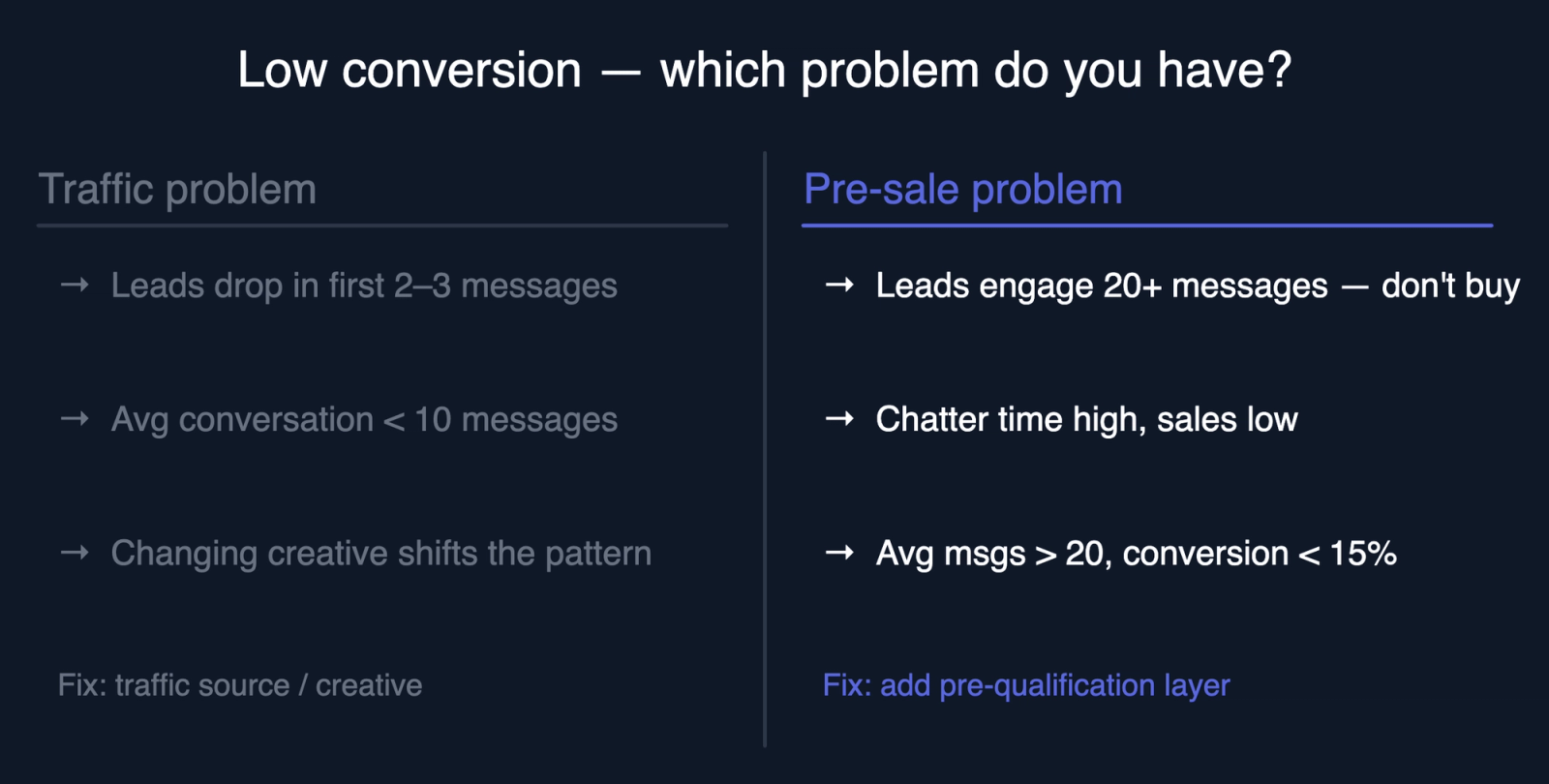
You have a traffic problem if:
-
Average messages per conversation sits consistently under 10
-
Leads drop in the first 2 to 3 exchanges or don't respond at all
-
The same profile of non-buyer shows up repeatedly: same geographic origin, same acquisition source
-
Changing the creative or the acquisition channel materially shifts the engagement pattern
You have a pre-sale problem if:
-
Leads are engaging, having real conversations, but not converting
-
Chatter shift time is high relative to actual sales generated
-
Your chatters describe spending most of their shift on leads who "seemed interested but didn't buy"
-
Average message count sits above 20 but conversion stays below 15%
Most agencies diagnosing low Telegram conversion are staring at a pre-sale problem and treating it as a traffic problem. The result is an endless loop of creative testing that never moves the number. The creative was never what broke it.
Which Traffic Sources Produce the Best Telegram Leads
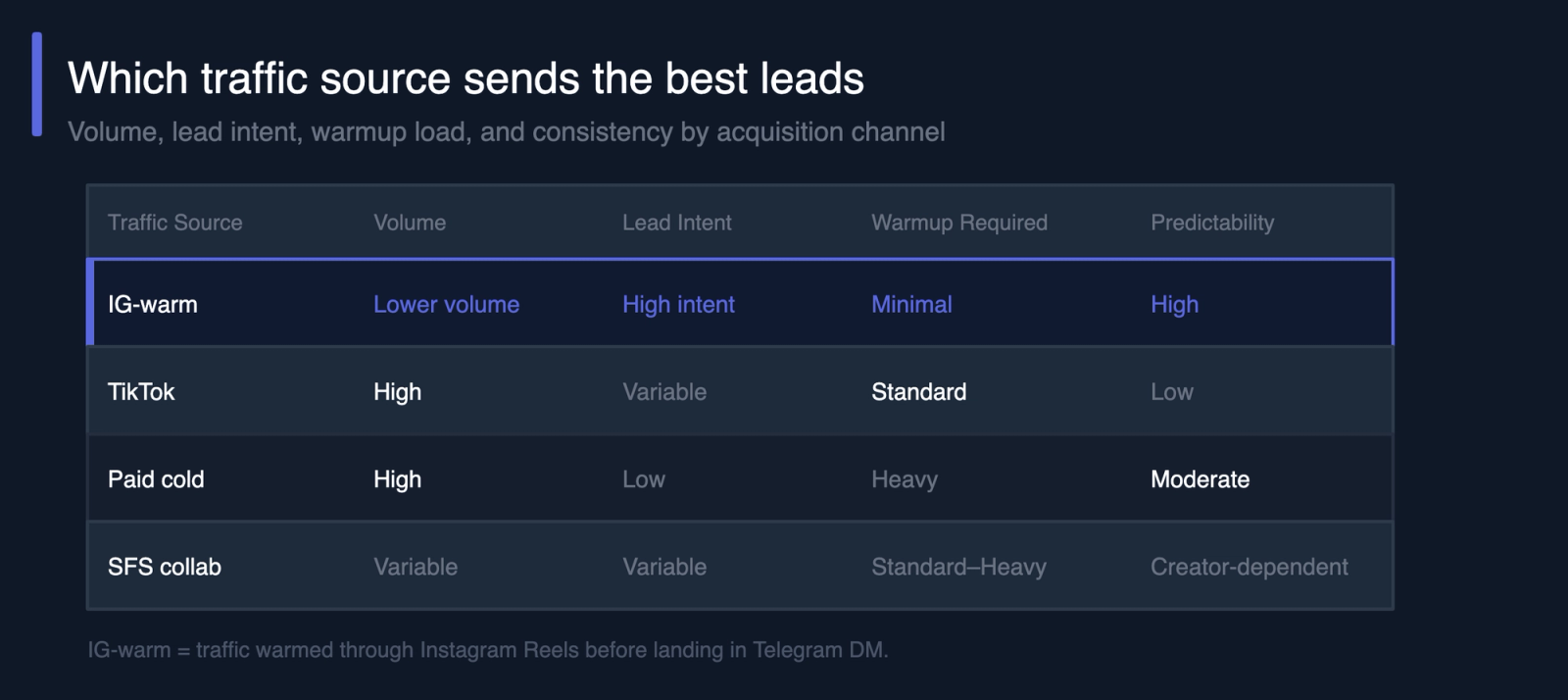
IG-warm leads are the ones who went looking for the link themselves. Not clicked from an ad, not redirected. Someone sat through enough Reels that they actually went and found the DM link in bio. By the time your AI chatter picks them up, they've already done the work you'd normally be doing in the first two phases. Whether that translates to a close still depends on the persona and the warmup arc, but the starting point is better.
TikTok brings volume, and some of it converts fine, but you'll burn through a lot of conversation slots on people who messaged because they had nothing else to do that afternoon. Hard to tell in advance which is which. Within the first 200 conversations you'll start seeing a clear gap versus IG-warm, and then you can calibrate your expectations to something more realistic.
Paid cold and SFS collabs are harder to generalize. Paid cold means the warmup phase has more ground to cover before anything's ready to sell. SFS collab quality comes down entirely to whose audience it is. Right creator, you get leads close to IG-warm. Wrong one, you get people who clicked for the free content and were never going to pay. You won't know which you're dealing with from the first few conversations, and sometimes not for a while after that.
How to Fix the Pre-Sale Layer
The pre-sale layer does two things. It qualifies leads and warms them up. Both need to happen before a human chatter takes over.
Qualification is about information. Age, location, life situation, financial signals. These data points surface in the conversation if someone asks the right questions in the right order.
Warmup is harder to define. It's the part where the lead stops being a stranger. Not through clever scripting. Through consistent engagement that makes the next step feel like a natural progression, not a pitch.
Both can run without a human in the room. The setup runs in three steps.
-
Set up a dedicated Telegram account for the creator. Not the creator's personal account. A separate, fully configured account with a clean phone number and complete profile.
-
Connect an AI chatter. It handles the warmup and qualification arc automatically, across every new conversation, at any volume. Define the creator persona carefully before turning it on. A thin persona produces thin conversations.
-
Set your qualification thresholds. The AI chatter scores leads at hand-off. Decide in advance what score triggers your chatters' attention. For most agencies, 3.5 and above is where chatter time generates consistent return.
When the pre-sale layer runs automatically, the chatter's job changes. They start with a queue that's already been scored and warmed up. Not ready to warm up. Ready to close.
This works best for agencies with consistent inbound volume. If you're still testing acquisition channels and lead flow is irregular, fixing the pre-sale layer is still the right call. It'll just take longer to see the signal.
The One Metric That Matters
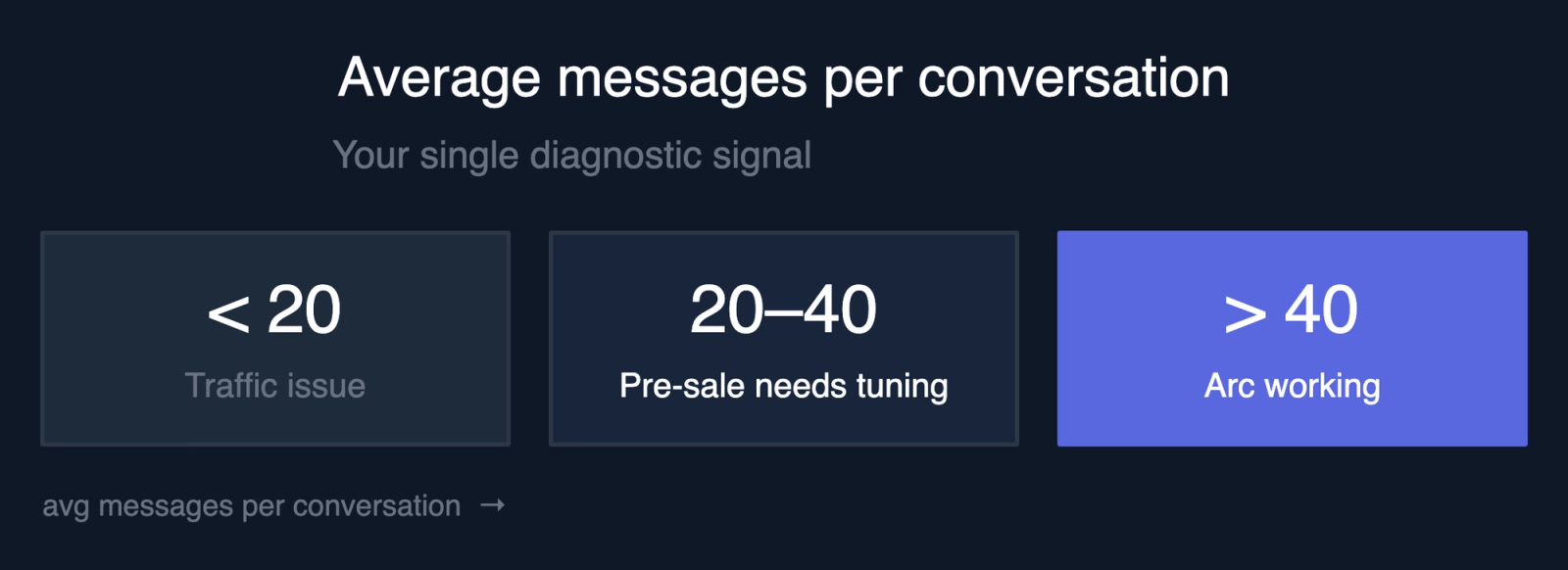
Pull one number from your analytics. Average messages per conversation.
Above 40 means your leads are engaging. The pre-sale arc is working. If conversion is still low, look at the handoff, not the warmup.
Between 20 and 40 means engagement is moderate. The warmup is running but you're probably losing leads before the qualification threshold. Find where conversations drop off.
Under 20 means leads aren't investing. Could be traffic quality, a thin creator persona, or a conversation structure moving at the wrong speed.
The volume of conversations is a vanity metric. Average message count is the signal.
What Changes When You Fix It
Nobody talks about what actually changes. Not the conversion rate, at least not immediately. The chatter's job itself.
A chatter working a pre-qualified queue isn't filtering. They're closing. That's a different skill, a different energy, and over time a different performance ceiling. You stop hiring for patience and start hiring for persuasion. The team gets better at the right thing.
The warmup still happens. The qualification still runs. It just happens before anyone on your payroll touches the conversation. Automatically, at scale, without that cost embedded in every sale.
That's a different operation. It's also a more profitable one.
Common Questions
How long does a warmup actually take?
A warmup takes 20 to 40 minutes manually. That's the standard range for building rapport and running qualification before the ask makes sense. At 1,000 conversations a month with 80% non-buyers, that comes out to 267 to 533 hours of chatter time each month on leads who were never going to convert. With an automated pre-sale layer, that cost moves off the chatter's plate entirely.
What conversion rate should I expect with an AI pre-sale funnel?
The benchmark for a well-configured AI pre-sale funnel on warm inbound traffic is around 30%, compared to the 8 to 15% manual baseline. IG-warm traffic with a complete persona configured in the chatter consistently reaches or exceeds that. Cold paid traffic with a thin persona sits toward the lower end. Fix the pre-sale layer and measure for 30 days before drawing conclusions. The signal takes volume to appear.
Can't I just run the pre-sale arc manually?
You can run a structured pre-sale arc manually with qualification scripts and phase discipline enforced. The problem is consistency under pressure. Manual chatters break phase discipline on hour 7 of a shift, across 4 simultaneous conversations. The arc gets shorter. The ask arrives earlier. Conversion drops. An automated layer runs the same arc on every conversation regardless of volume or time of day. For agencies handling more than a few hundred Telegram conversations per month, manual execution doesn't hold up.
**
See how ChatSan qualifies and warms up your Telegram leads automatically
Sources
-
"Response Time Matters," InsideSales, 2021. https://www.insidesales.com/response-time-matters/
-
"The Short Life of Online Sales Leads," Harvard Business Review, March 2011. https://hbr.org/2011/03/the-short-life-of-online-sales
-
"OnlyFans 2024 Financials: Gross Revenue $7.2 Billion, up 9%," Variety, 2025. https://variety.com/2025/digital/news/onlyfans-fiscal-2024-revenue-earnings-1236495750/
-
"The Creator Economy Could Approach Half-a-Trillion Dollars by 2027," Goldman Sachs, 2023. https://www.goldmansachs.com/insights/articles/the-creator-economy-could-approach-half-a-trillion-dollars-by-2027
-
"How to Prevent Telegram Account Blocking," Enreach.ai. https://www.enreach.ai/insights/how-to-prevent-telegram-account-blocking