What Is a GFE Funnel? (And Why It Converts Better Than a Reply Bot)
Published April 13, 2026
Most agencies running AI chatters are building a reply bot and calling it a GFE strategy. The ones converting at 30% are doing something structurally different. Here's the gap.
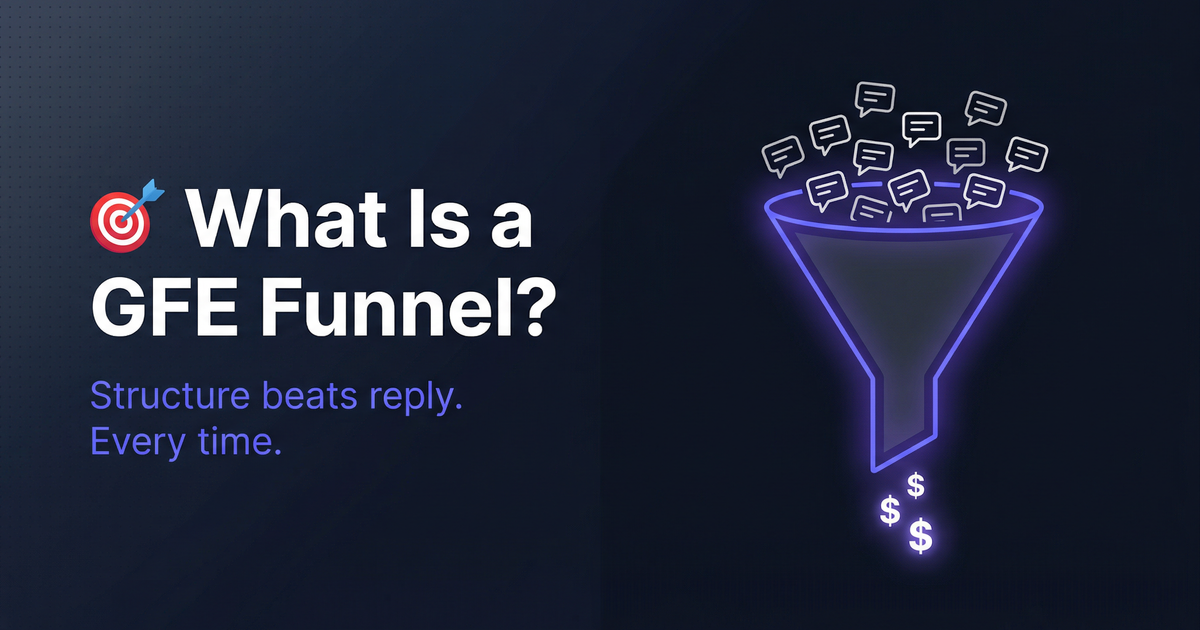
Your AI chatter is running, replies fast, sounds human enough, and keeps conversations going. Your conversion rate sits at 10% and you can't figure out why. You've tried better prompts, tighter scripts, different closers, and nothing has moved it. Replies aren't the gap. A GFE funnel is a structured, phase-based conversation methodology that builds emotional investment from cold introduction to qualified, scored, ready-to-buy lead, and replies alone were never going to get you there.
Tone Isn't the Problem
The agencies converting at 30% stopped asking whether their chatter sounds warm enough. They started asking whether the lead has had a reason to invest yet.
GFE stands for girlfriend experience. In OFM it's a specific interaction style, personal and reciprocal rather than transactional. The confusion happens because if your creator sells explicit content, the girlfriend experience starts looking like a content category. It isn't. What defines it is the quality of the emotional connection, not what's being sold. The lead feels like they're talking to someone genuinely interested in them, someone who asks about their life, shares about their own, and builds something rather than angling toward a sale.
You see this in the numbers before you can explain it conceptually. A lead who gets a sales push before any rapport has formed almost never converts. The offer arrives before the emotional investment exists to justify it. A lead who's shared something real and felt heard arrives at the sales moment in a completely different state. The content offer isn't an external transaction. It's the obvious next step in a relationship they're already inside.
The GFE is the framework for building that investment. The funnel is what makes it repeatable at scale.
How Every Good Chatter Already Runs This
Watch a good human chatter work a cold DM thread and you see the same arc every time. Opener, connection, escalation, close, in that order, without thinking about it.
A lead enters cold. Skeptical, probably. By the end they're scored, emotionally engaged, ready to close. The path between those two states isn't improvised.
Every skilled human chatter already runs a version of this sequence intuitively. They don't jump straight to sexualization from message one. They don't ask for payment before building rapport. They work through it in the same order every time, opening warm and moving toward the close in a way that makes the offer feel natural when it arrives.
That arc works. It just lives entirely in their head, which means it varies by chatter, by mood, by shift, by how stretched the rota is. When a chatter moves too fast or skips the relational phase, conversion drops and you have no idea why. No structure to audit, no phase to check.
A structured pre-sale funnel takes that sequence out of the chatter's head. Every lead goes through the same arc at the same pace. What comes out the end is a qualified, scored lead ready for your chatters to close.
What the Arc Actually Looks Like
A structured pre-sale funnel has seven distinct phases. Each builds on the previous one.
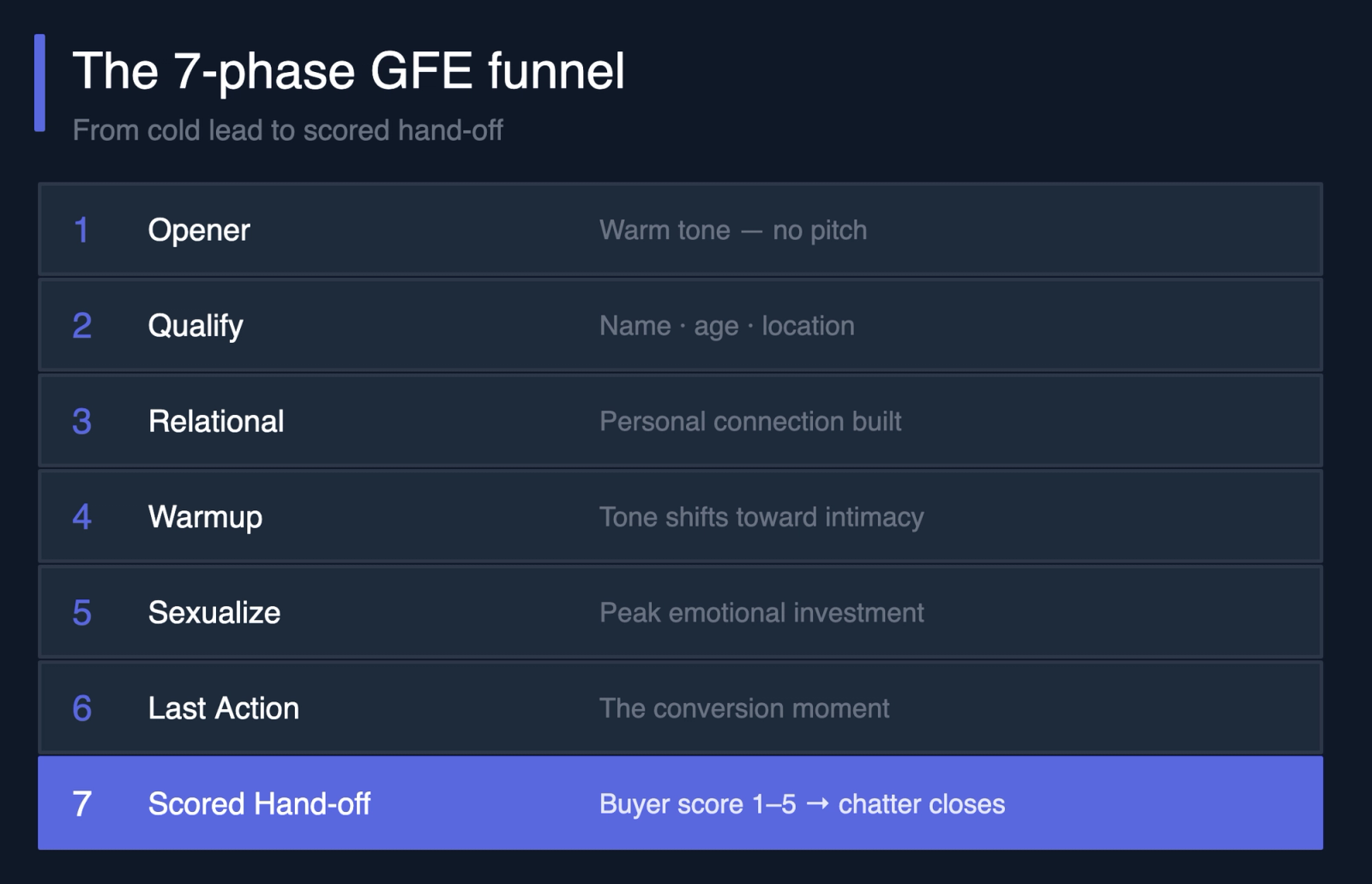
Phase 1: Opener
The lead sends a first message. What happens next sets the tone for everything. Acknowledge them warmly, give the conversation somewhere to go. Too eager reads as desperate. Too cold reads as disinterested. The opener is done when the conversation moves naturally toward getting to know each other.
Phase 2: Qualification
The funnel gathers data here. The method looks nothing like data collection because the creator shares something real about themselves first, then asks. Where they grew up. What their week looks like. Something a little personal, offered voluntarily.
People reciprocate. Not because they're being manipulated, but because when someone opens up about themselves, the natural response is to match it. The lead answers. Name, age, city, whether they're in a relationship, what they're actually looking for. More detail than you'd expect from a cold DM thread.
That information does two jobs. It feeds the scoring model at hand-off, where age and location are the strongest predictors of purchasing power. And it builds the familiarity that makes everything from Phase 3 onward feel earned rather than pushed.
The creator never just asks. They share first. Always.
Phase 3: Relational
Qualification has produced a profile. The relational phase deepens the connection.
This phase goes into shared interests, personal histories, the sentimental side of life. Past relationships, what the lead is looking for, how they connect with people. It's the phase where the lead stops being a stranger and starts feeling like someone the creator actually knows.
Most of the emotional investment gets built here. Leads who go through this phase fully convert at a meaningfully higher rate than leads who skip it. The margin isn't small.
It's also the first phase that gets cut when the rota is stretched or the volume is high. If you've ever seen your conversion drop without knowing why, this is usually where to look. Not the copy. Not the offer. The relational phase got shortened and the lead wasn't ready when the last action arrived.
One reason AI funnels outperform manual chatting isn't that AI does it better. It's that AI never skips it.
Phase 3.5: Content Introduction
Before escalation begins, the creator introduces why they sell content. Not a sales pitch. A personal story that frames content as an expression of intimacy and seriousness, not a commercial transaction.
The lead isn't being sold to. They're being let into the creator's reasoning. This phase plants intent without creating pressure.
Phase 4: Warmup
The conversation shifts in tone. The creator begins moving toward more personal territory, sharing experiences, creating tension, testing whether the lead is willing to go further.
The warmup is a gateway. Its job is to move the lead from emotional connection to active engagement and to qualify whether they're willing to go deeper. The phase ends with a clear signal from the lead about their intent.
Phase 5: Sexualization
The escalation phase builds a shared, progressive arc. The lead is an active participant, not an audience.
Structure matters more than content here. Too fast, and the lead doesn't feel invested. Too slow, and momentum dies. The arc builds gradually, with the creator maintaining control of the pace, always leaving the lead wanting more rather than giving everything at once.
This phase produces peak emotional investment. A lead who's been through a well-run escalation is at their highest willingness to pay. The last action arrives at exactly that moment.
Phase 6: Last Action
The final message before hand-off. Payment link, platform redirect, soft close. Whatever fits your conversion flow, just not a generic message.
The previous five phases have been building toward this. A lead who's gone through the full arc is at peak willingness to act. The last action's job isn't to persuade. It's to make the next step feel like the obvious continuation of something they're already inside.
Phase 7: Scored Hand-off
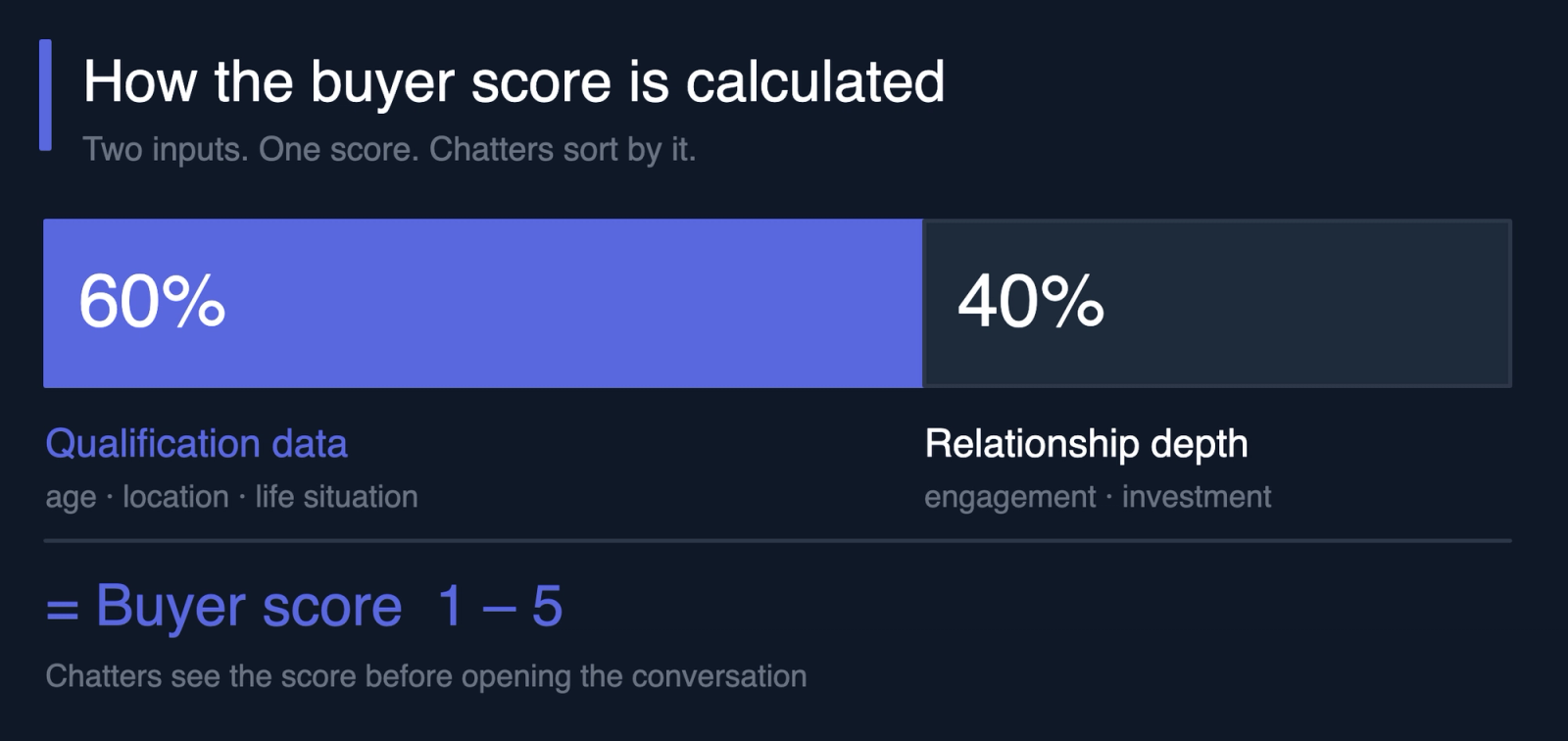
The funnel closes with a buyer score from 1 to 5 assigned to the lead. Qualification data accounts for 60% of it, drawn from age, location, and life situation as signals of purchasing power. Relationship depth makes up the other 40%, based on engagement quality, emotional investment, and how the lead responded to the content introduction.
Your chatters see the score before they open the conversation. High scores get first attention. Low scores may not be worth their time at all.
The score determines order before any chatter opens a conversation.
Why Reacting to Messages Isn't a Strategy
A reply bot receives a message and generates a response. No arc. No memory of where the conversation was supposed to go.
It doesn't know where the lead is in their emotional journey. It optimizes for the current message, not for the conversion outcome at the end of a 50-message sequence.
The result is conversations that may feel natural in isolation but go nowhere structurally. The lead engages, the AI chatter responds, and nothing is building toward a close. When the last action arrives, it lands on a lead who hasn't been brought to the right emotional state.
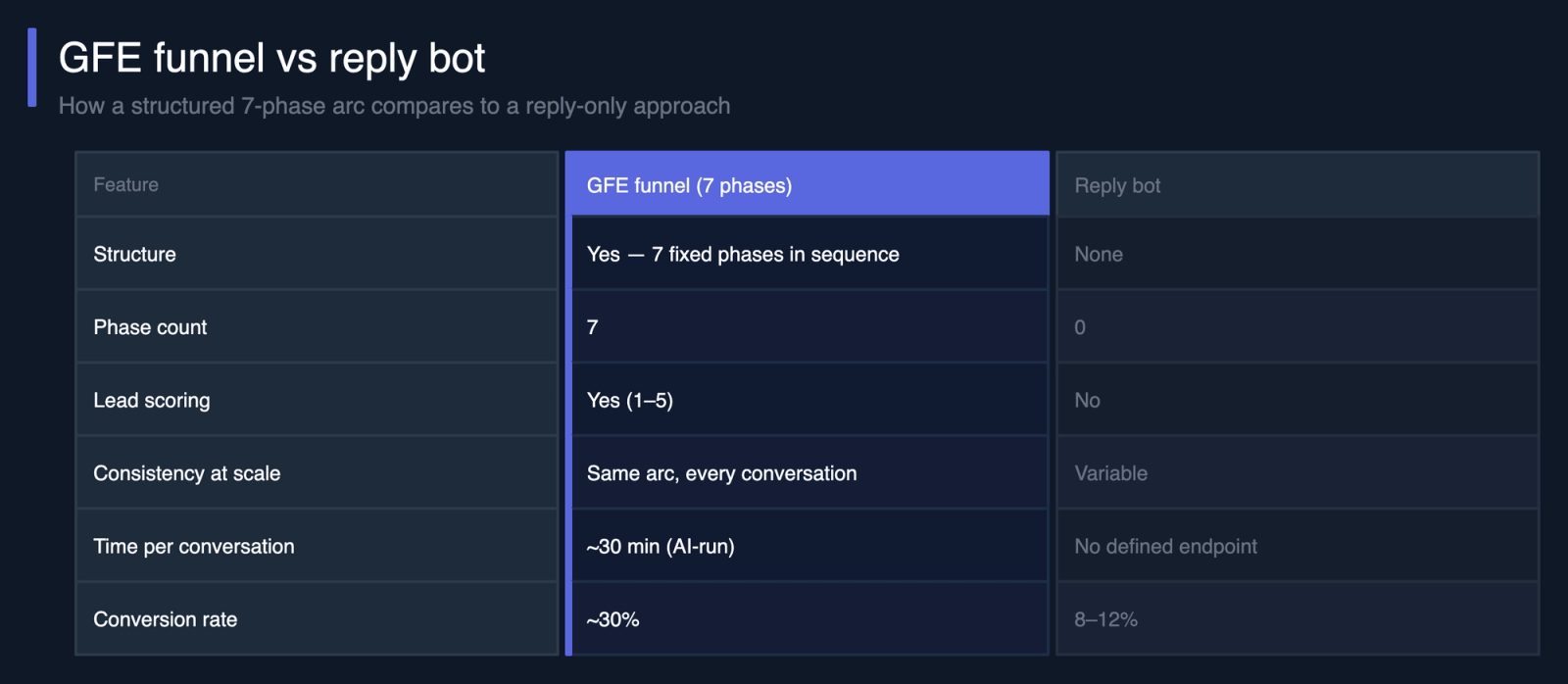
Manual chatting, the most sophisticated reply-only approach available, converts at 8 to 15% across the OFM industry by most operator estimates. Structured AI-run funnels target 30%. Roughly double the best-case manual rate.
The gap has nothing to do with how good the replies sound. It's whether those replies serve a structure or just react to the last message.
Why "Sound Warmer" Never Fixes It
Most agencies that can't get GFE conversion to work are adjusting the wrong thing.
They treat the girlfriend experience as a tone adjustment. Tell the AI chatter to "sound warmer" or "be more personal." The chatter adjusts its vocabulary. Conversion barely moves. Vocabulary was never the issue.
Sequence is. A warm-sounding reply at the wrong phase in the wrong order doesn't build emotional investment. It just delays the same dead end. The GFE only converts when the seven phases run in the right order, at the right pace, with the right goal at each stage.
If you've tried an AI chatting tool and it didn't work, nine times out of ten it was CupidBot. CupidBot sends around 30 templated messages and redirects. Not a structured funnel. A seven-phase sequence with lead scoring and a configurable last action is a different product entirely.
The Headcount Trap
You can't run a pre-sale funnel manually at scale without serious headcount. Each conversation requires 20 to 40 minutes of skilled chatter time across five or six phases. As inbound volume grows, the cost grows with it.
What actually happens at scale is that the funnel starts getting compressed. Phase 3 goes first, chatters skip it or rush through it. Then Phase 3.5 disappears entirely. By the time you're managing 200 leads a day manually, most conversations are running Phase 1, a shortened Phase 2, and jumping straight toward the close. Fast replies with extra steps at best.
The ceiling isn't headcount. Manual execution degrades the thing that makes the funnel work.
An AI chatter runs the same funnel on every new conversation at the same time, same arc, same emotional pacing, without the headcount cost. What comes out the end of every conversation is a qualified, scored lead ready for the human chatter to close.
It's not about AI being better than a skilled human chatter. A good chatter will build deeper connection in a single conversation. What AI does is run the pre-sale sequence on 200 conversations at once, at the same quality, for a flat monthly fee. Your chatters spend their shift on the leads who scored high enough to close.
Worth stating plainly. ChatSan warms up and scores leads but doesn't close them. Your chatter does. If your closing motion is broken, a better funnel won't fix it. The funnel gets the lead ready. What happens next is still on the human.
The Number That Changes Things
At a thousand conversations a month, an AI chatter at 30% conversion hands off 300 scored, ready-to-buy leads to your chatters. A reply bot at 10% hands off 100, most of them cold.
With the girlfriend experience build, the subs come in already spent up on her — half the sale happened before your chatter typed a word. Reply bots get you whatever the Thursday night guy felt like doing, which some months is 8% and some months is 14%.
That 200-lead gap between the two is real margin, not a rounding error.
Three volume levels. $20 average sale, AI chatter at 30%, manual GFE at 12% (the upper end of realistic sustained execution).
Common Questions
What's the difference between a script and a GFE funnel?
A script is a fixed sequence of messages. A GFE funnel is a phase-based framework with a goal for each phase and a clear condition for when to advance. Scripts move forward on a timer or message count. The GFE funnel moves forward only when the lead has actually demonstrated something in that phase. Reciprocation in Phase 2, emotional engagement in Phase 3, a clear intent signal in Phase 4. A script can push a lead to Phase 6 regardless of how invested they actually are. A properly structured funnel won't.
How long does an AI-run funnel take?
An AI-run funnel takes approximately 30 minutes of elapsed conversation time on average, depending on how quickly the lead responds. The AI handles pacing without delays on your end. Manual execution runs 20 to 40 minutes of active chatter time per lead, not including wait time between messages. That figure compounds across every conversation in the queue simultaneously, which is what makes manual execution expensive at scale.
What happens if a lead tries to skip ahead?
If a lead tries to jump ahead, a structured funnel holds pace. The chatter acknowledges the lead's energy but returns to where the arc needs to be. Moving too fast to Phase 5 when a lead hasn't completed Phase 3 produces a lead who isn't emotionally invested enough for the close to land. The phase structure isn't arbitrary. Each one builds the emotional state the next one depends on. Leads who skip early phases convert at lower rates even when they seem enthusiastic, because enthusiasm in Phase 1 isn't the same as investment in Phase 3.
See how ChatSan runs a 7-phase GFE funnel on every Telegram conversation
Sources
-
"OnlyFans Statistics" — Business of Apps, 2024. https://www.businessofapps.com/data/onlyfans-statistics/
-
"Creator Economy Market Size" — Goldman Sachs Research, 2023. https://www.goldmansachs.com/insights/pages/the-creator-economy-could-approach-half-a-trillion-dollars-by-2027.html
-
Manual chatter conversion rates (8–15%) and AI chatting benchmarks (25–40%) are operator-reported estimates widely cited in OFM agency communities. No single published study exists; figures reflect the range reported across practitioner sources.