How to Scale an OFM Agency Without Hiring More Chatters
Published April 10, 2026
The OFM agency scaling ceiling isn't chatter skill. It's warmup volume. Here's what changing that equation actually looks like, without adding a single chatter.
Creator seven just signed. You already know who's going to handle the inbound.
Scaling without hiring sounds like it shouldn't work. Creator count climbs, inbound follows, and somewhere a third chatter shows up on the payroll because there's no other option. Except there is. It's what happens when you take the warmup phase off the chatters' plates entirely and hand it to something (almost someone) that doesn't sleep.
An AI chatter handles every conversation from first message to scored handoff. Your human chatters only see leads who are already qualified and ready to close.
The ceiling moves. That's the whole thing.
Where the Scaling Ceiling Actually Comes From
The ceiling isn't the close. It's not either the content strategy or the chatter skill level.
It's the warmup phase.
Every new Telegram lead who DMs a creator account needs to go through a pre-sale arc before they're ready to buy. That arc takes a skilled chatter 20 to 40 minutes per lead, with no guarantee the lead converts. And here's the thing most agency owners don't want to sit with: 70 to 80% of those conversations produce nothing regardless of how well the chatter ran them. All that weight, distributed across every account, every shift, every new creator you sign.
Every creator you add generates more inbound. More inbound means more warmup volume. More warmup volume means more headcount to absorb it.
The ceiling isn't skill. It's not conversion technique. It's the sheer volume of pre-qualification work that has to happen before any of that becomes relevant.
The Cost of Linear Growth
Run the numbers.
Agency at 5 creators:
-
5 Telegram accounts, each averaging 200 new conversations per month
-
Total inbound: 1,000 conversations/month
-
2 chatters working in shifts, each handling 3-4 accounts simultaneously
-
Each chatter covers warmup + closing for their assigned accounts
-
Monthly chatter cost: $3,000-$5,000 (salary or commission, depending on structure)
Agency adds creators 6-8:
-
Total inbound grows to 1,600 conversations/month
-
Current team cannot absorb additional volume without quality dropping
-
Hire a third chatter: +$1,500-$2,500/month in fixed cost
-
Chatter 3 also needs setup time, account access, training on creator personas
Agency adds creators 9-12:
-
Inbound at 2,400 conversations/month
-
A fourth chatter is needed
-
Total chatter cost is now $6,000-$10,000/month
-
Each new creator adds fixed operational cost before they generate net new profit
Revenue grows. So does the chatter payroll, almost step for step. Margin stays flat, and you've hired another person who needs onboarding, account access, training on creator personas, and a couple weeks before they're actually useful.
That's not scaling. That's a treadmill.
What About Outsourcing Chatting Instead?
Some agencies try to solve this with outsourced chatters. FVAChatting and ChatterApply are real services, freelance chatters who work across multiple agencies. You're not adding a full-time employee, the fixed cost looks lower, and you can flex volume up or down without carrying headcount.
The problem is structural. Outsourced chatters still run warmup. Every conversation they open still starts from zero, still takes 20 to 40 minutes per lead to qualify, still burns time on the 70 to 80% who won't buy. The warmup cost doesn't disappear when you outsource. It gets embedded in the per-hour or per-conversation rate you pay the service. You just stop seeing it as a separate line item.
At low volume it's a reasonable short-term fix. You're not carrying headcount between bursts of inbound. At scale, the math lands in the same place it does with employees. Warmup hours compound, cost follows creator count, and margin doesn't improve.
Outsourcing changes who runs the warmup. It doesn't change the fact that warmup runs at all.
What Most Agencies Get Wrong
Most agency owners think scaling means hiring more chatters. It doesn't if you're smart.
Scaling means changing what chatters do, not adding more of them. That's a different problem entirely, and most agencies never get there because they're too busy solving the wrong one.
The issue isn't that your chatters are slow or bad at their jobs. It's that they're spending 70% of their shift on conversations that will never convert. Warmup is slow, and slow at scale gets heavy fast.
Closing is what generates revenue, yes I know that sounds obvious. But you have to understand that the agencies growing the fastest figured it out and stopped using chatters for warmup long before you. And that's why I know the ones stuck at five creators haven't.
What Changes When Warmup Runs Without a Chatter
Before: a chatter opens their shift, picks up whatever conversations are active across their accounts, and starts from zero. They warm up whoever came in overnight, qualify leads, build rapport, move toward the offer. Some of it goes somewhere. Most doesn't. By the end of the shift they've moved through forty conversations and closed two.
With automated warmup the shift looks different. A chatter logs in and finds a queue of leads who've already been through the full pre-sale arc: qualification done, rapport built, a buyer score on each one. They look at the scores, open the highest-value conversations, and close.
Same chatter. Same eight hours. Very different day.
How the Scaling Equation Changes
The interesting thing about adding a creator when warmup is automated: it doesn't add a chatter.
A new creator means a new Telegram account. That account generates inbound. The AI chatter handles every conversation on it, from first message through scored handoff. The only thing that grows with creator count is the qualified lead queue, not the total warmup volume.
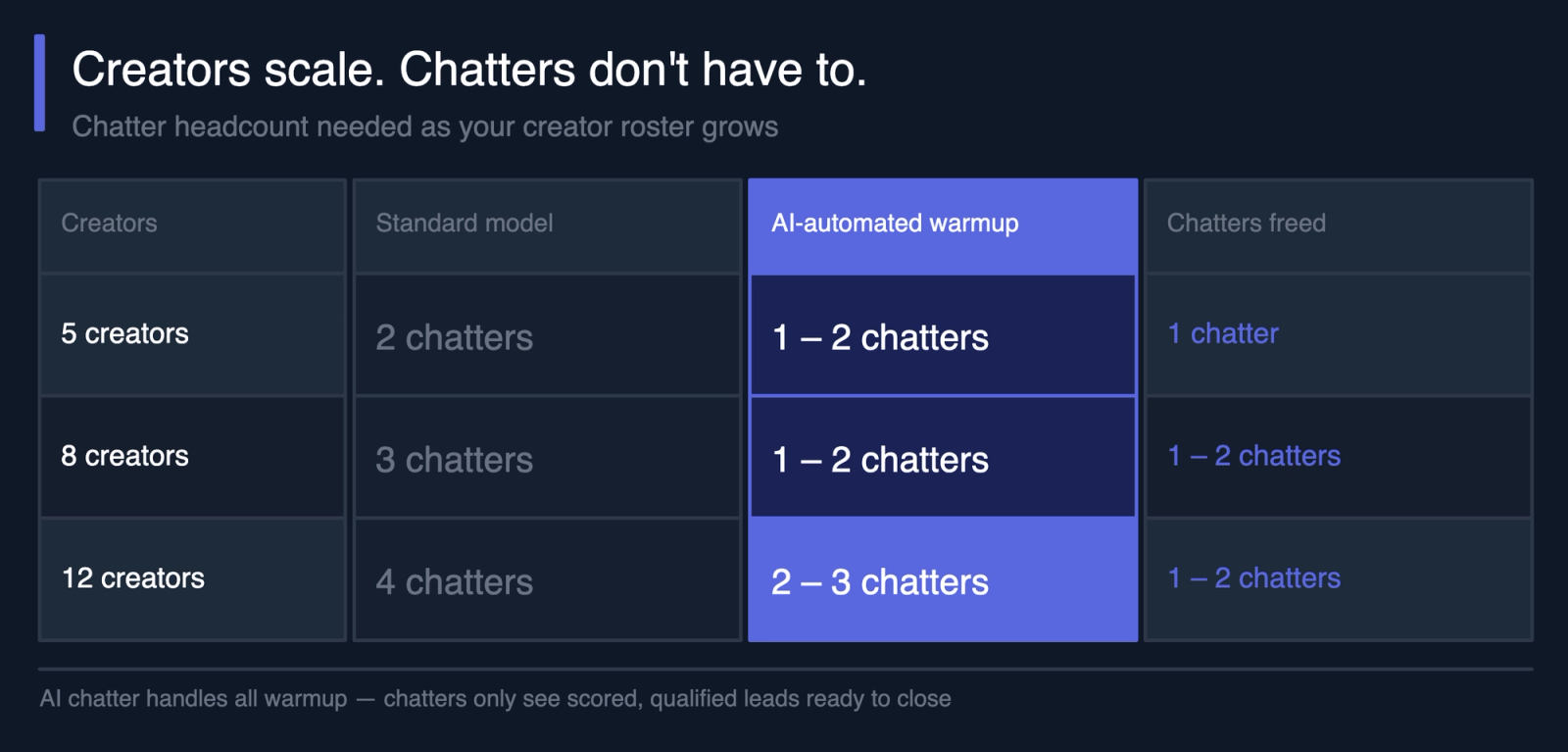
Same agency, same scale, different architecture:
Chatter headcount grows with the number of qualified leads to close. That's it. And because chatters only close, their output per hour is higher. They're not burning 70% of the shift on conversations that produce nothing.
Creator count and inbound climb together. Chatter headcount barely moves. That gap is where the margin lives.
What Automated Warmup Actually Costs
The flat fee doesn't grow with revenue. It grows with conversation volume, and the per-conversation cost drops as volume climbs.
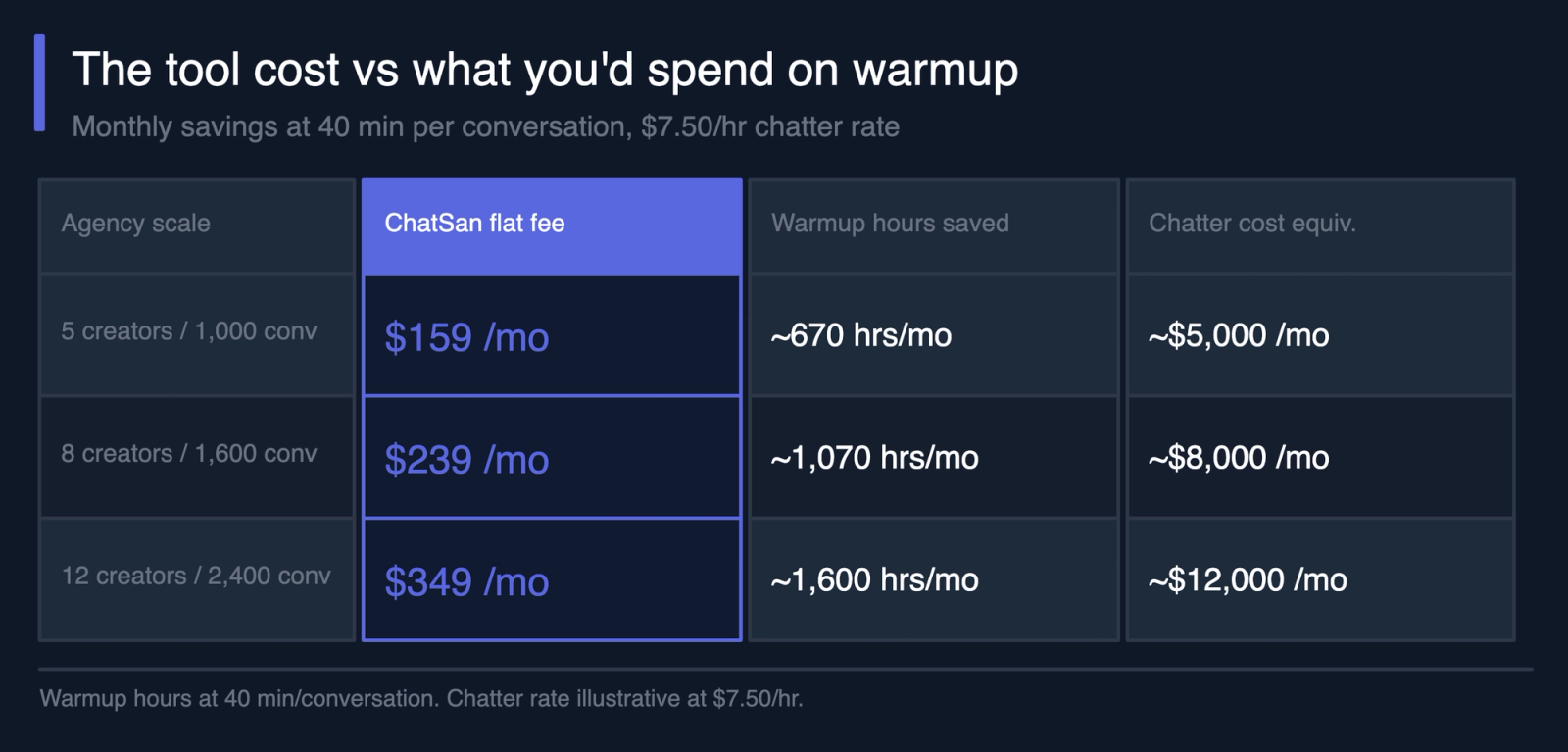
Warmup hours calculated at 40 minutes per conversation. Chatter rate illustrative.
Tool cost is fixed. Chatter-hour savings compound. At five creators it's a reasonable swap. At twelve, you're looking at a pretty absurd gap between what the automation costs and what you'd have paid in warmup hours.
You Still Need Chatters to Close
The obvious pushback: "I still need chatters to close."
Right. You do.
ChatSan warms up, qualifies, scores, and hands off. It'll not close sales and it's not trying to. Your chatters still close, and that's the point.
Free a closer from warmup and you don't just save time. You change what they produce per hour. A chatter who only closes is a completely different asset than one who also runs warmup. Most people underestimate how much of a difference that is, and they should probably think about that before the next hire.
ChatSan changes what the role is for. That's worth more than replacing it.
What to Get Right Before Adding Creators
This isn't a single switch. The setup determines whether the qualification rate justifies the change.
One creator first.
Every agency that scales this well starts with one creator. Not to test the concept. Because no brief teaches you what creator one does: what traffic actually converts, whether the persona lands right, whether the Last Action configuration holds when real volume hits it. That's really when qualification rate and message count are stable that you're ready to duplicate.
Traffic is coming with the creator.
Adding a creator without a dedicated acquisition source adds overhead, not revenue. Each account needs a real traffic source behind it: a bio link that actually gets used, a posting rhythm, something that makes people DM. The AI chatter handles what arrives. Your job is making sure enough of the right people do.
Chatters shift to closing.
If chatters still open new conversations and warm from zero, the gain disappears. Actually, this is the part most agencies get wrong and it's not that complicated: chatters work from the qualified lead queue, sorted by buyer score, focused on conversations ready to close.
Scale creator by creator.
One creator's conversion metrics stable, then the next. Each new creator is a copy of what already works. Not a new experiment every time.
The Real Ceiling on OFM Agency Growth
OFM agencies don't have a demand problem. Traffic exists. Creators are ready to sign, and most agency owners already know which ones.
Where it breaks is always internal.
It's the cost and friction of managing the human layer that sits between inbound traffic and closed sales. The warmup phase. That's where the drag is. It pulls on every account, every shift, harder as volume grows.
Warmup hours don't convert. Closing hours do. Every shift has a fixed number of hours, and that ratio matters more than headcount. Run it monthly and that gap is what the agency is leaving behind on traffic it already paid for.
Taking warmup off the chatter's job isn't a cost-cutting exercise. It's the only change that makes adding a creator feel lighter instead of heavier.
Common Questions
Can I run without any human chatters at all?
Not if you want to close sales. The AI chatter handles the full pre-sale arc and scores leads, but it doesn't negotiate, handle objections, or run the PPV escalation loop. That part still requires a human. What changes is how many humans you need. At 1,000 conversations per month with automated warmup, one strong closer working a scored queue can handle what previously needed two chatters running warmup and closing combined. The floor is roughly one closer per 300 to 400 qualified leads per month, depending on how fast they work and your average message count per close.
What CRM tools work alongside this?
Most agencies track at the creator level in Telegram folders and spreadsheets. Some use Notion or Airtable for agency-wide reporting. Nothing OFM-native integrates cleanly with Telegram conversation data at this point. ChatSan's dashboard surfaces buyer scores and conversation status directly, which replaces most of what agencies were building in spreadsheets manually. For agencies managing 10 or more creators, the score-sorted Conversations table in ChatSan is usually enough for chatter prioritization without a separate CRM layer.
How many creators do I need before automation makes sense?
This works at any volume. One creator at 100 convo/mo goes from 12 closes to 30. That's $360 in additional monthly revenue on a $19 tool. The math works before you even have multiple creators. Where creator count starts to matter though is the warmup-hours calculation. Once you're running 3 to 4 creators at 200 conversations each, the warmup hours start to exceed the flat fee. That's a secondary signal. The better signal is message count. If your chatters are spending more than 60% of their shift on warmup rather than closing, the math holds regardless of how many creators you're running.
Add your next creator to ChatSan, same flat fee, no new chatters
Sources
-
"OnlyFans Statistics and User Data (2024)," Business of Apps, March 2024, https://www.businessofapps.com/data/onlyfans-statistics/
-
"Creator Economy Market Size, Share & Trends Analysis Report," Goldman Sachs Research, April 2023, https://www.goldmansachs.com/insights/articles/the-creator-economy-could-approach-half-a-trillion-dollars-by-2027.html
-
"The State of the Creator Economy," Linktree, 2023, https://linktr.ee/creator-report